- Screen Colours:
- Normal
- Black & Yellow
Location
North Cove is a village and civil parish in the Waveney district in the north of the English county of Suffolk. The village is on the A146 around 3 miles (4.8 km) east of Beccles and 5 miles (8.0 km) west of Lowestoft. It merges with the village of Barnby although the two parishes retain separate parish councils. The village is on the edge of the Broads and to the south of the River Waveney.
The East Suffolk Line runs on the northern edge of the village, although the nearest station is at Beccles.
History
North Cove is not mentioned in the Domesday Book, although Barnby is described as a medium-sized village at this time, and it is likely that the parish was part of Worlingham at this time. The name probably refers to a creek from the then tidal estuary of the River Waveney and the village first appears in its own right in documents in 1204. Archaeological remains suggest that there was
Romano-British habitation in the area in the 2nd to 4th century.
The parish church dates from the 12th century, and Wade Hall is a moated manorial site on the edge of the marshes to the north of the village which dates from the medieval period. This includes a mound which was possibly a tower platform.
The manor, which was sometimes called Wathe, is recorded as being held by Robert Watheby of Cumberland in the 12th century. Wade Hall itself dates from the 17th century and is a listed building. North Cove Hall, on the western edge of the village, dates from the 17th century and is a Grade II listed building.
In 1848 North Cove is recorded as having a population of 219 with the parish having annexed that of Willingham St Mary to the south. Within the parish is the site of the lost village of Worlingham Parva which was recorded in the Domesday survey. This village had a round tower Saxon church dating from about 950 and dedicated to St Peter. Remains of the church and cemetery, including burials, were discovered in 1980 when a bypass was built around Beccles. The church is known to have still been in use in 1474.
Church
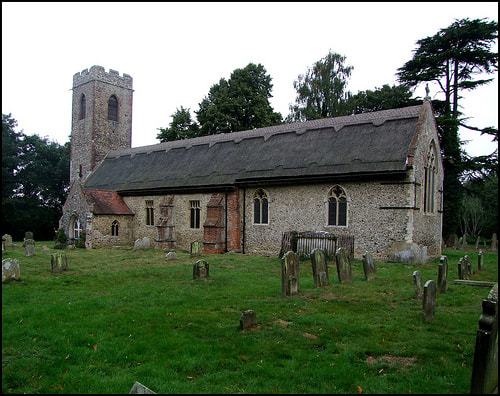
The parish church is dedicated to St. Boltoph and contains medieval wall paintings and a thatched roof. It dates from the 12th century and has a number of medieval features including doorways and windows and a 15th-century square tower. It is a Grade I listed building which was rebuilt in parts in the 19th century.
The wall paintings are thought to be 14th century in origin and have been judged to be "some of the finest surviving medieval wall-paintings in all East Anglia". The paintings depict the Passion of Christ and judgement day. They were painted over in the later medieval period, restored in the 19th century and then in the 1990s to return them to their original condition.

Fortrey Heap Hall
Regular activities are held at the local village hall.

Public House
The village also contains a public house, The Three Horseshoes, which dates from the 17th century.